

Format Hard Drive
Screenshots are being added: so far 2 from the receiver and 7 from the web interface; the aim is at least 5 of each, with arrows and frames, and, where a setting changes what you see, a before and after comparison.
English screenshots coming: some of the pictures below still show the receiver and the web interface in Romanian. The rows, keys and steps described on this page are the English ones.
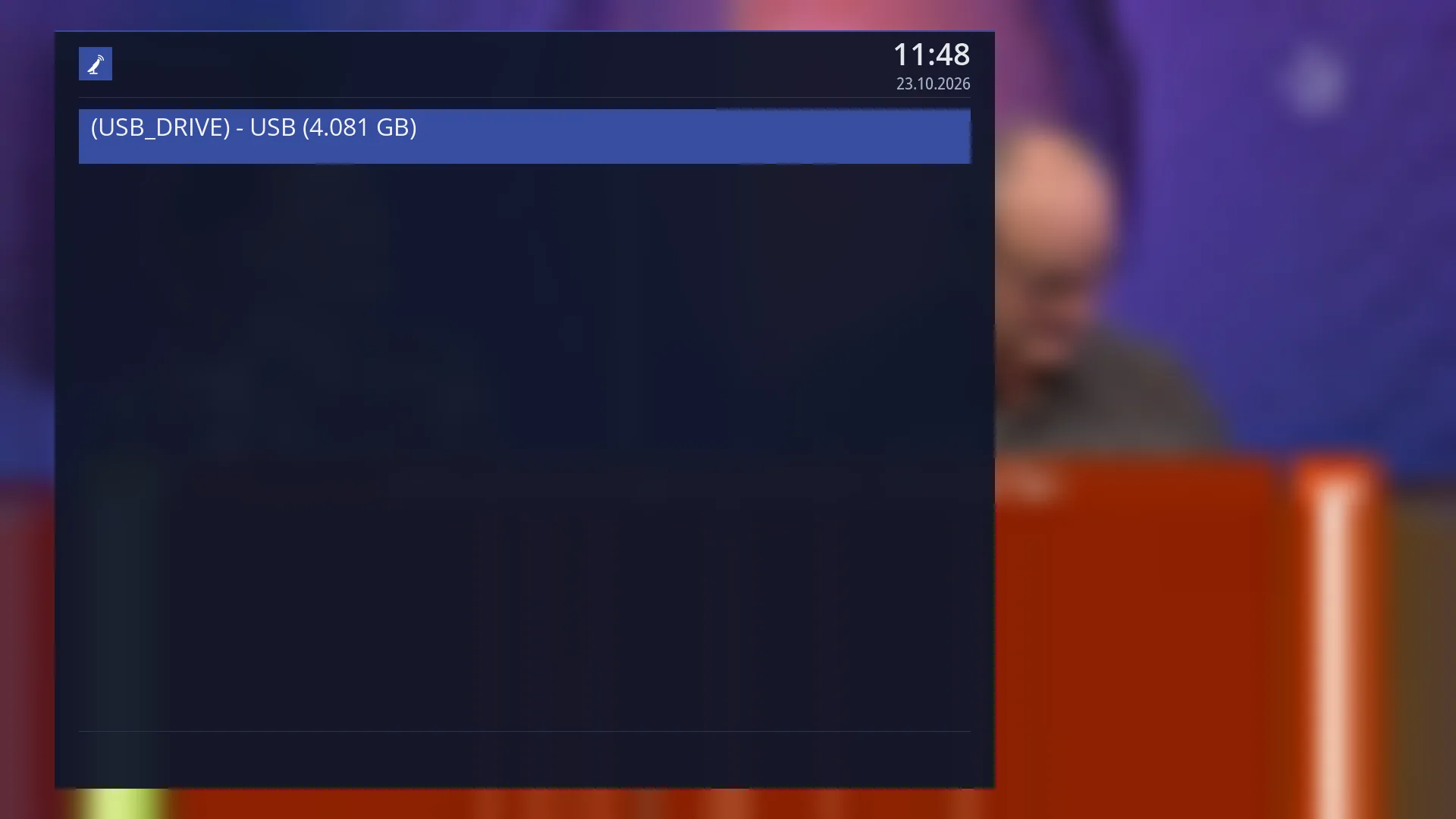
- 1 A disk in the list: the model, the connection (USB) and the capacity; OK opens it.
- 2 Other hard disks and USB sticks appear here, each on its own row.
- 3 The clock and the date; the screen has no title yet.
What it is for
“Format Hard Drive” prepares a hard disk or a USB stick for the receiver. It erases everything on it and creates a single partition with a file system the receiver can read and write, plus the folder for recordings (movie).
Use it for a new disk or USB stick, for one formatted on a computer with a file system the receiver cannot write to (exFAT, for example), or when you want to empty it completely.
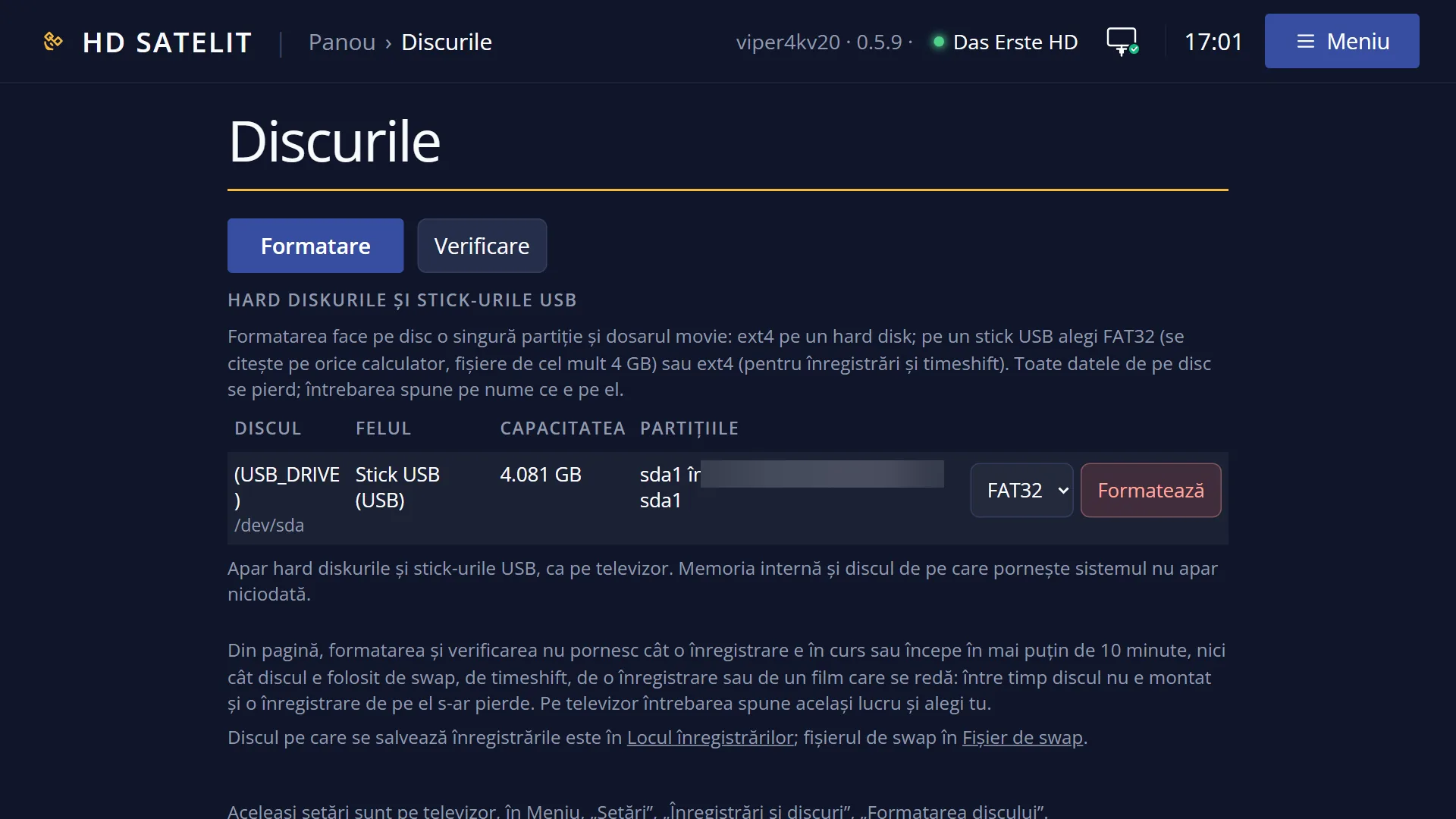
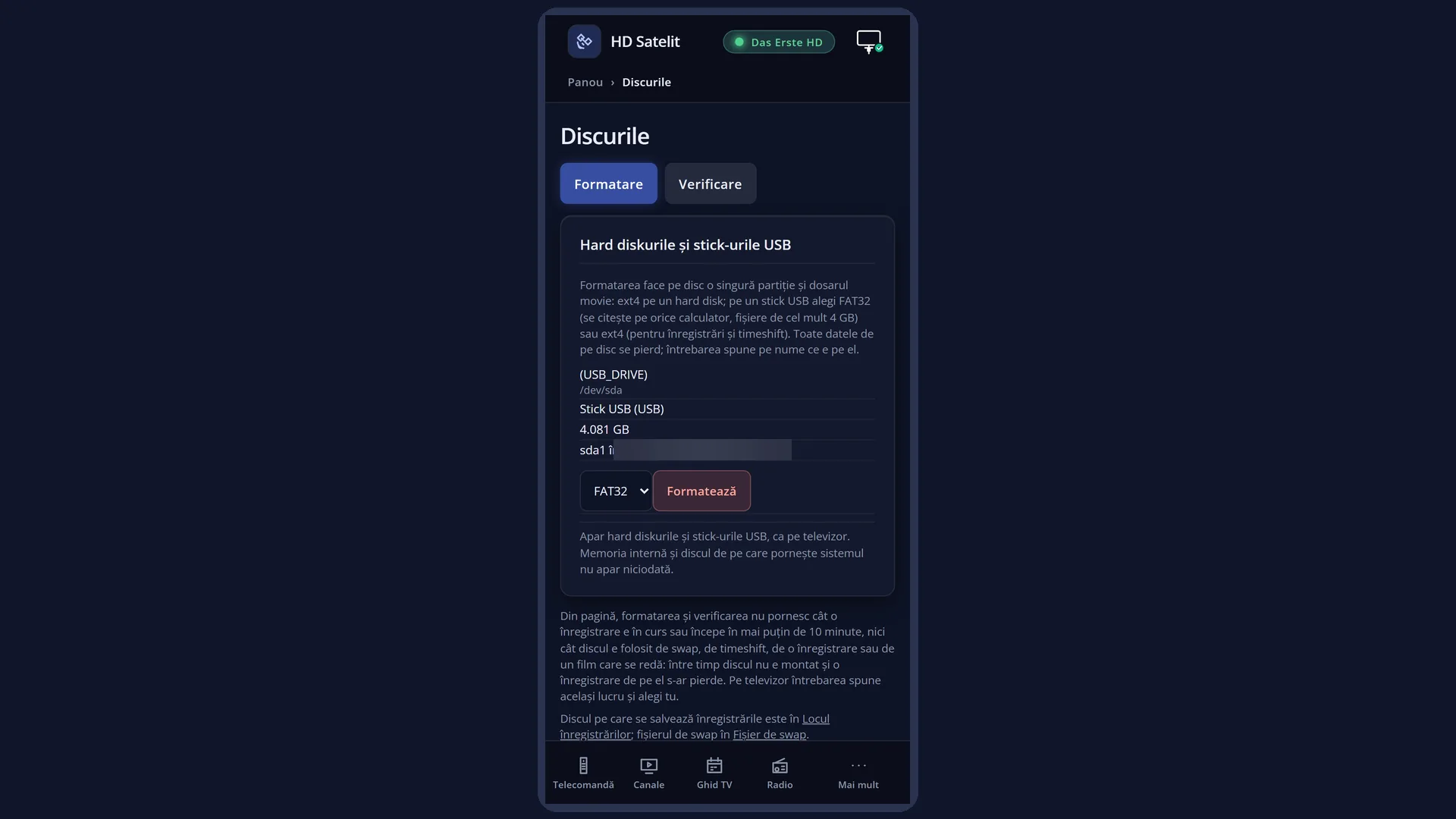
A hard disk gets ext4. For a USB stick you choose: FAT32, which any computer reads (a file can be at most 4 GB, so a long recording is split into pieces), or ext4, for recordings and timeshift (files of any size; a Windows computer cannot read it without extra software).
Before anything happens, the receiver tells you exactly what will be lost: settings backups, images for the receiver, how many recordings there are, the swap file and how much space is used. The default answer is “Cancel”.
The disk the system starts from and the receiver's internal memory never appear in the list, so they cannot be erased from here.
How to get here
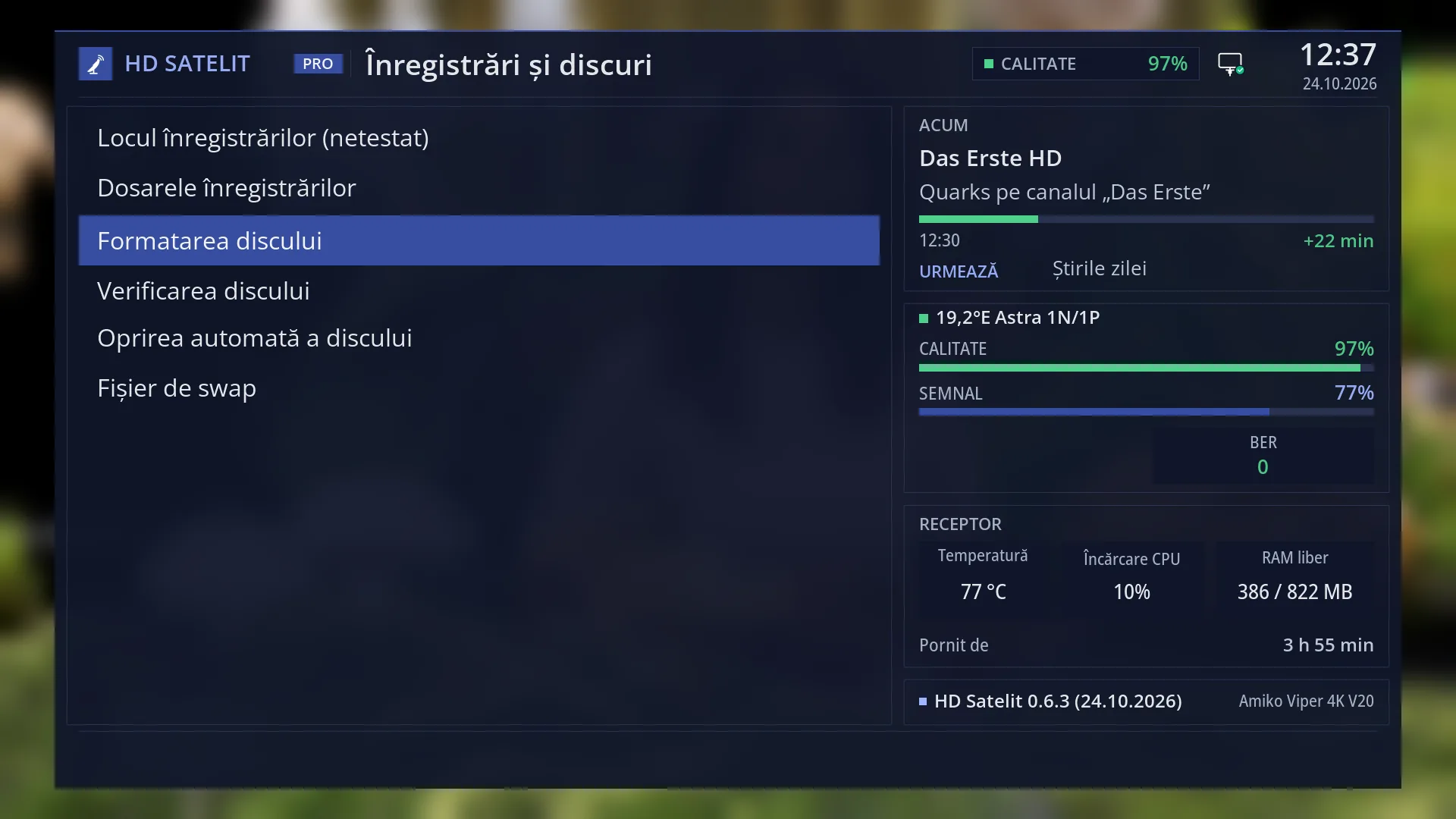
Path: Main menu > Settings > Recording & Storage Setup > Format Hard Drive.
Keys on the TV: MENU 6 5 3.
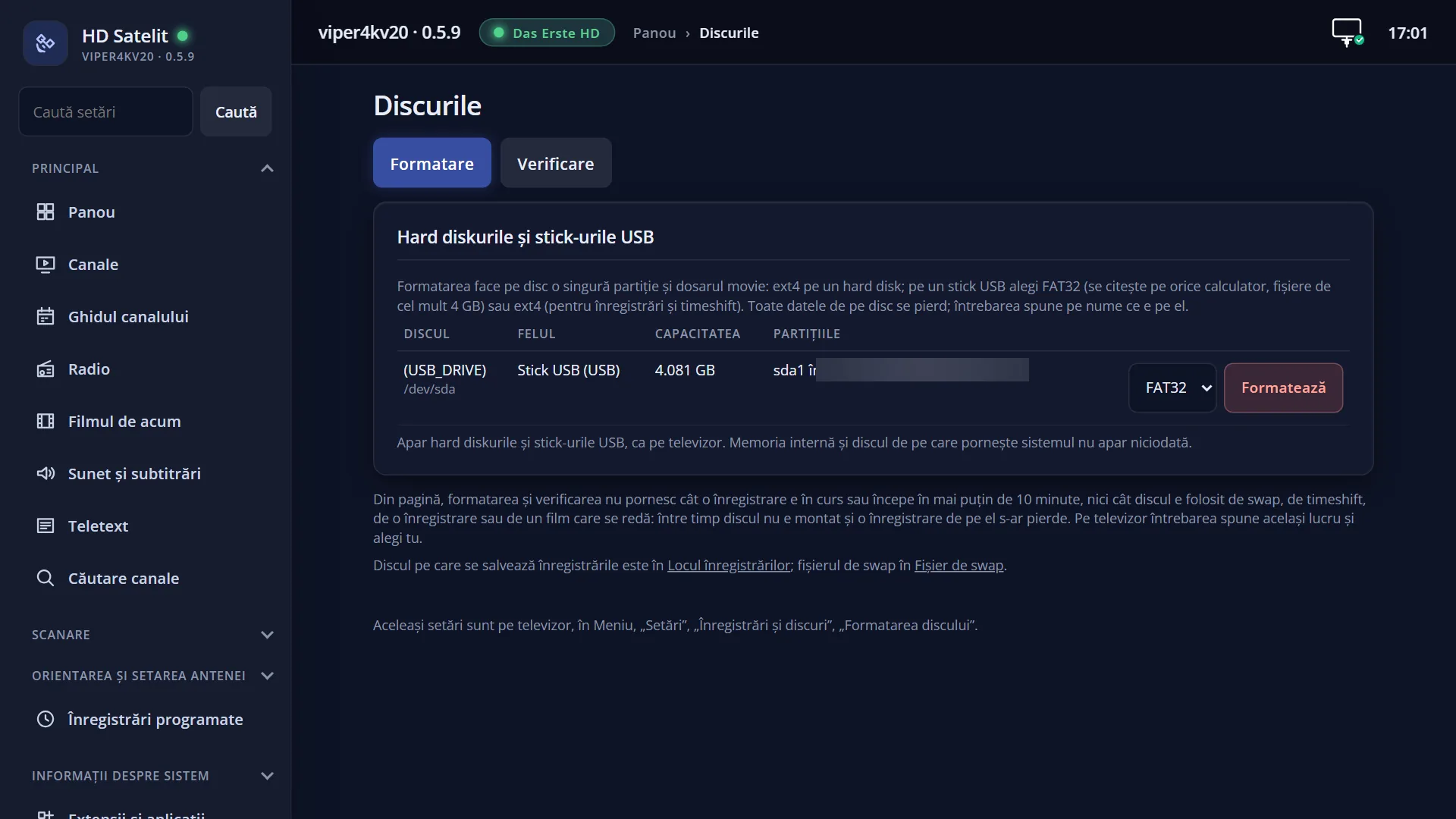
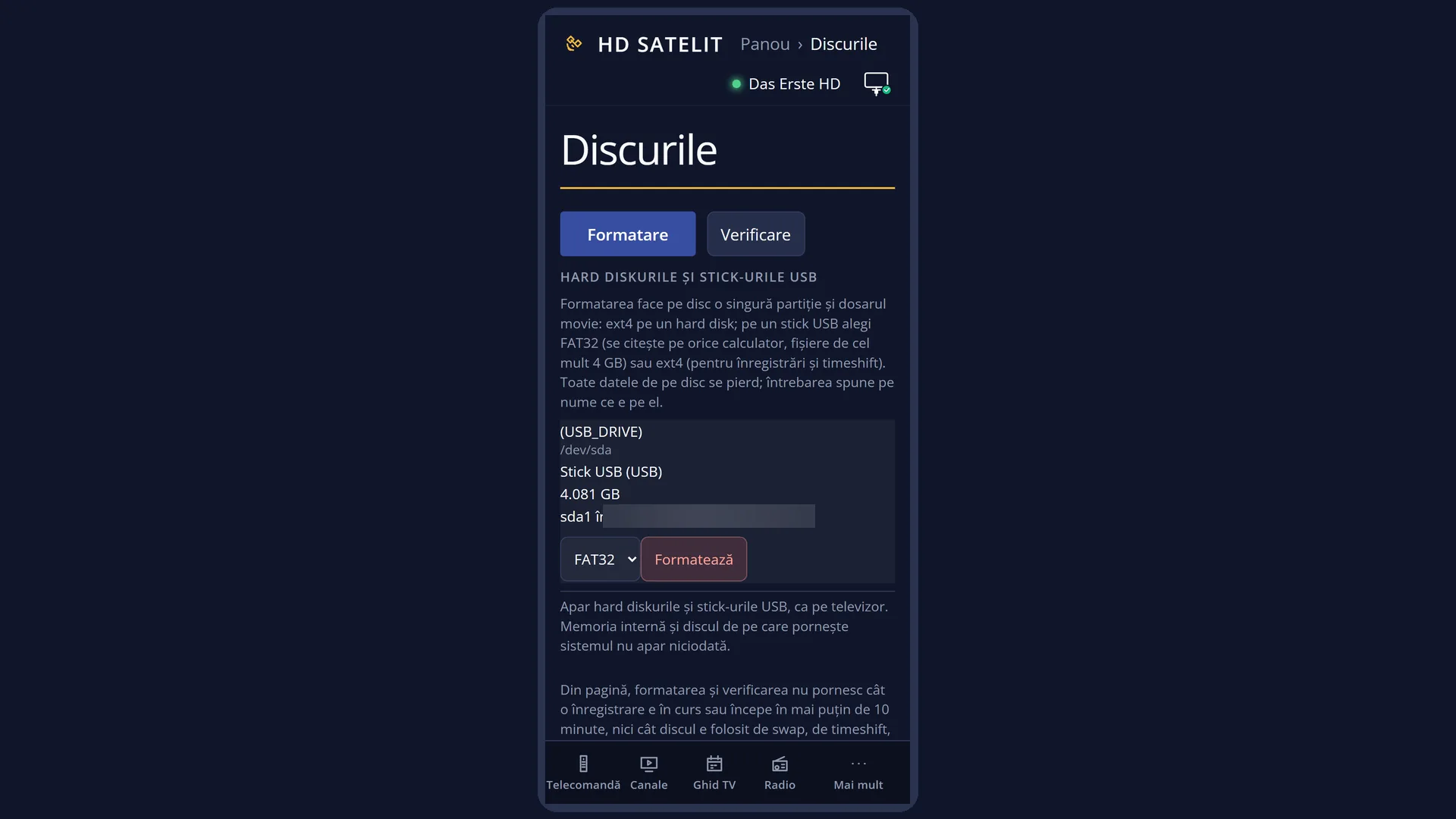
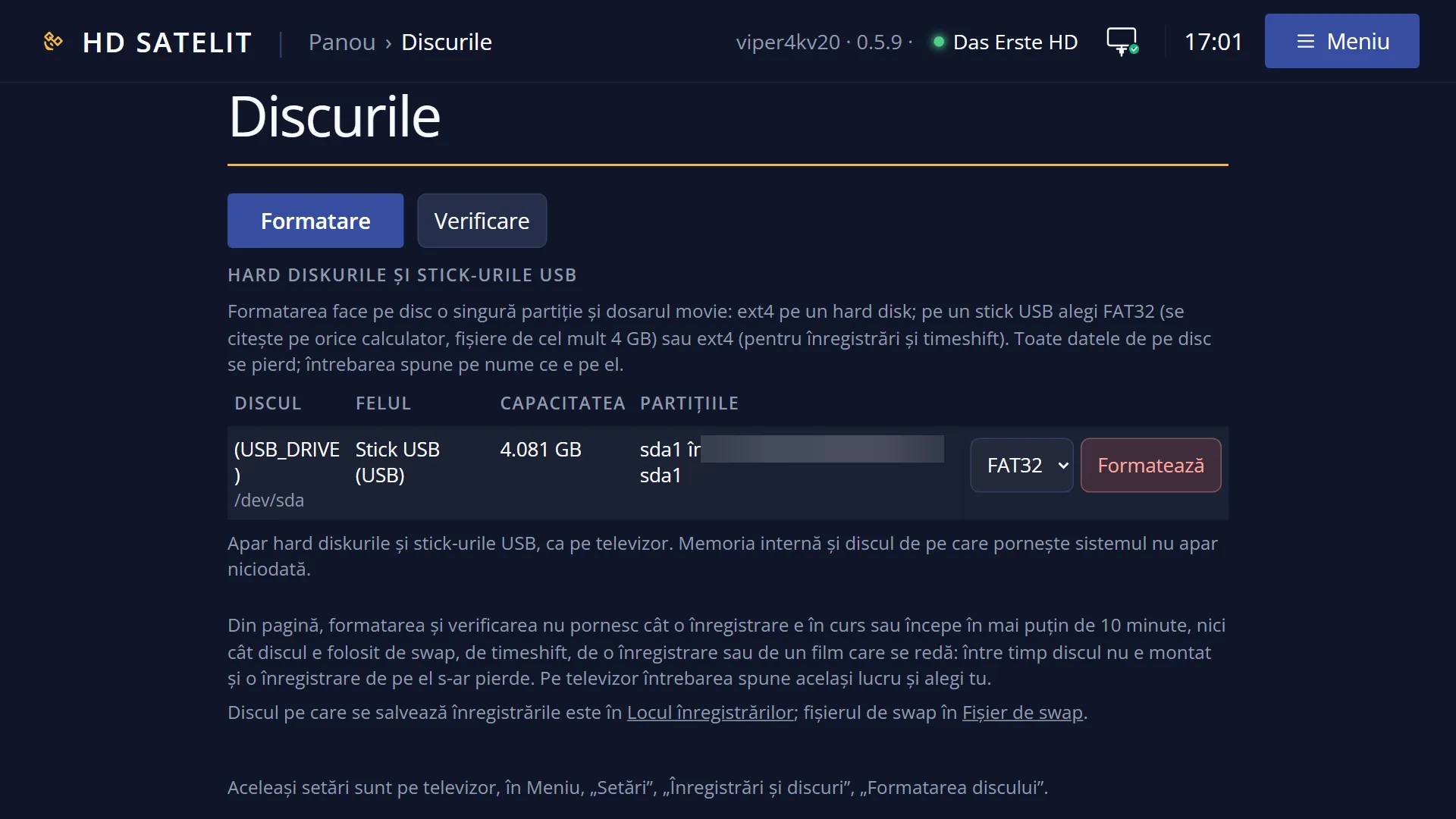
In the web interface: the page /discuri?f=formatare (“The disks”, “Formatting” tab), with the same list, the same choice of file system and the same question, confirmed in two steps.
What you see on the screen
The first screen is the list of disks: one row for each hard disk and each USB stick, with the model, the connection and the capacity, for example “(USB_DRIVE) - USB (4.081 GB)”. Hard disks come first, USB sticks after them. With no disk connected, it says “No hard disk and no USB stick found.”.
At the top you only see the clock and the date: the screen has no title yet.
After you press OK on a disk, the disk screen opens: “Model: ...”, “Capacity: ...”, “Bus: ...” and, in yellow, “Initialize”. From here you start formatting with the RED key.
For a USB stick, the list “Which file system do you format the USB stick with?” appears first, with “FAT32: any computer reads it” and “ext4: for recordings and timeshift”. For a hard disk this list does not appear: ext4 is used.
Then the main question appears, for example “Format the USB stick ... with FAT32? All data on it will be lost.” or “Initialize the disk ...? All data on the disk will be lost.”. Below it: the model, the capacity, where each partition is mounted, what the chosen file system means, “Also lost:” with the list of what was found on the disk and, if relevant, what is using the disk right now (a recording, live pause, a film that is playing). At the bottom: “Cancel” (the default) and “Yes, format” or “Yes, initialize”.
While it works, the window “Initializing Harddisk...” stays in the middle of the screen. Formatting usually takes up to two minutes.
Rows and settings
| Row | Values | Default | What it does |
|---|---|---|---|
| List of disks | each hard disk, each USB stick | You choose the disk to format. Only hard disks and USB sticks are shown; the system disk and the internal memory do not appear. When you have connected a disk or USB stick that you want to prepare. | |
| File system (USB stick only) | FAT32: any computer reads it, ext4: for recordings and timeshift | FAT32 (first in the list); on a hard disk, ext4 only | FAT32 works on any computer, and the receiver can write its image from such a USB stick in recovery mode, but a file can be at most 4 GB. ext4 holds files of any size and repairs itself after a sudden power cut, but Windows cannot read it without extra software. Choose ext4 for a USB stick you keep long recordings or live pause on; FAT32 for a USB stick you use to move files to a computer. |
| The confirmation question | Cancel, Yes, format (for a USB stick), Yes, initialize (for a hard disk) | Cancel | It tells you what will be lost and what is using the disk right now. Only “Yes” starts formatting; “Cancel” or EXIT changes nothing. After you have read everything that will be lost and moved what you need. |
Keys
| UP / DOWN | In the list of disks, move the cursor to another disk. |
| OK | In the list, opens the screen of the selected disk. In the disk screen, OK closes it without doing anything. |
| RED (in the disk screen) | Starts formatting: for a USB stick, first the choice of file system, then the question. |
| EXIT | Closes the current screen without changing anything. |
| In the question: UP / DOWN | Select the answer: “Cancel” or “Yes”. |
| In the question: LEFT / RIGHT | Scroll the text about what will be lost, when it is longer than the window. |
| In the question: OK | Chooses the answer the cursor is on. |
| In the question: EXIT | Cancels; nothing is erased. |
Step by step
Preparing a new USB stick for recordings
- Plug in the USB stick and press MENU 6 5 3.
- Select the USB stick with UP and DOWN and press OK, then RED.
- Choose “ext4: for recordings and timeshift” and press OK.
- Read what will be lost, move the cursor to “Yes, format” and press OK. Wait for the “Initializing Harddisk...” window to disappear.
- Then choose the USB stick as the place for recordings in “Recordings location” or in “Recording Locations”.
Formatting a USB stick that a computer can also read
- MENU 6 5 3, select the USB stick, OK, then RED.
- Choose “FAT32: any computer reads it” and press OK.
- At the question, choose “Yes, format” and press OK.
Problems and solutions
My disk does not appear in the list.
Only hard disks and USB sticks recognised by the receiver appear. Unplug it and plug it in again, wait a few seconds and open the screen again. The disk the system starts from and the internal memory never appear.
The message “Swap is on for this disk ... Turn it off first in Swap File.” appears.
While swap is running on the disk, the disk cannot be unmounted. Turn off swap in Settings > Recording & Storage Setup > Swap File, then try again.
The message “A disk operation is already running. Wait for it to finish.” appears.
A format or a check started from the TV or from the web page is still running. Wait for it to finish; only one job runs at a time.
The question says that a recording or live pause is writing to the disk.
While formatting runs, the disk is not mounted, so the recording or live pause can no longer write to it. Choose “Cancel”, wait for the recording to finish, stop live pause and try again.
The message “The hard disk could not be initialized. Error: ...” appears.
Unplug the disk, plug it in again and try once more. If it still does not work, the disk may be faulty or write-protected; try it in a computer.
I cannot find NTFS or exFAT among the choices.
The receiver cannot create these file systems. Choose FAT32 if you want to read the USB stick on a computer too.
On the FAT32 USB stick, a long recording is split into several pieces.
On FAT32 a file can be at most 4 GB. For long recordings, format the USB stick with ext4.
Formatting does not start from the web page.
The page refuses while a recording is running or starts in less than 10 minutes, and while the disk is in use (swap, live pause, a recording, an open file). On the TV the same things are shown in the question and you decide.
Related topics
- Check Disk Health
- Swap File
- Recordings location
- Recording Locations
- Recording & Storage Setup (the submenu)
- Settings copy (what is lost when formatting)
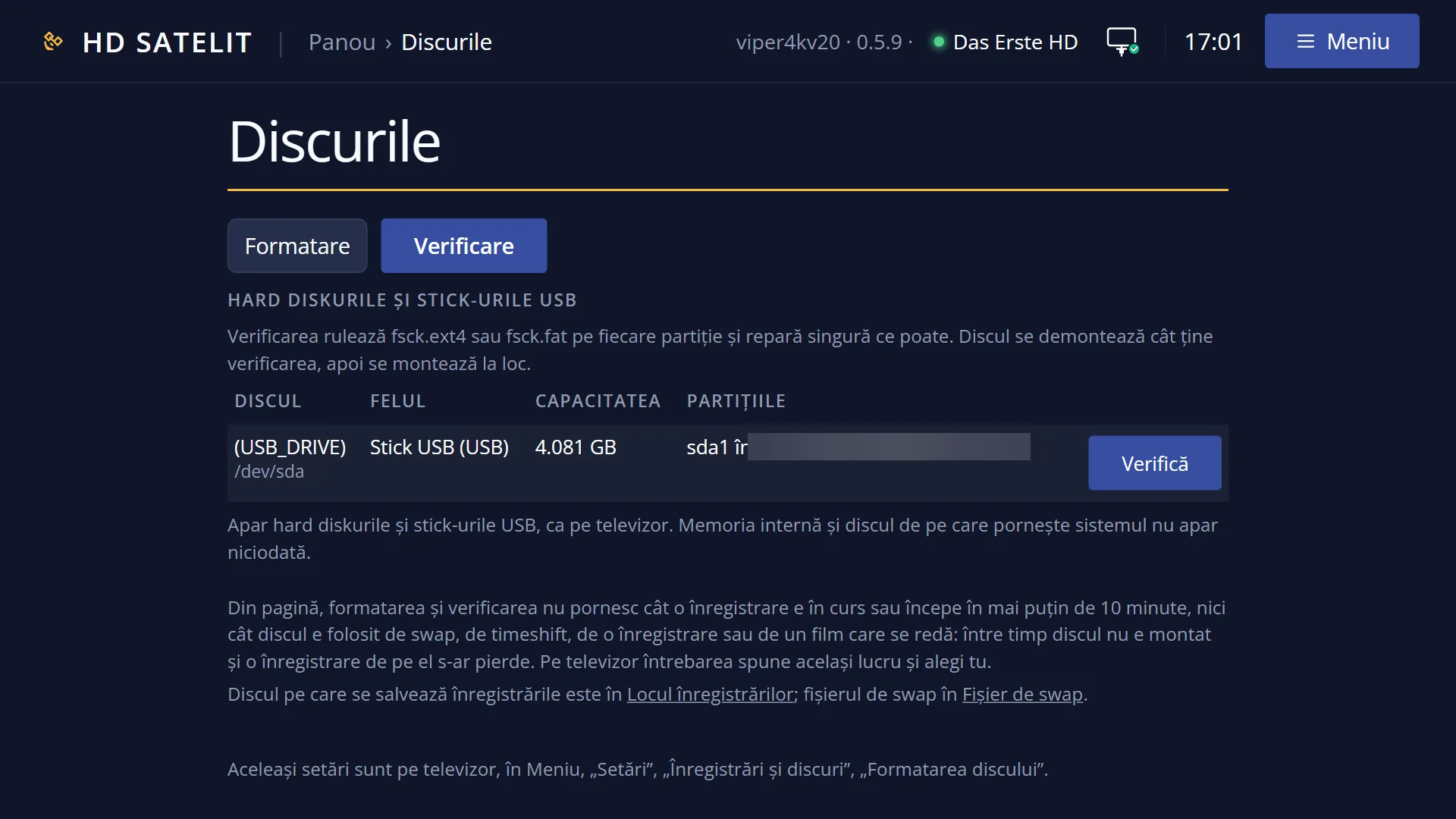
- Matching web page: /discuri?f=formatare.