

By frequency (cable)
English screenshots coming: some of the pictures below still show the receiver and the web interface in Romanian. The rows, keys and steps described on this page are the English ones.
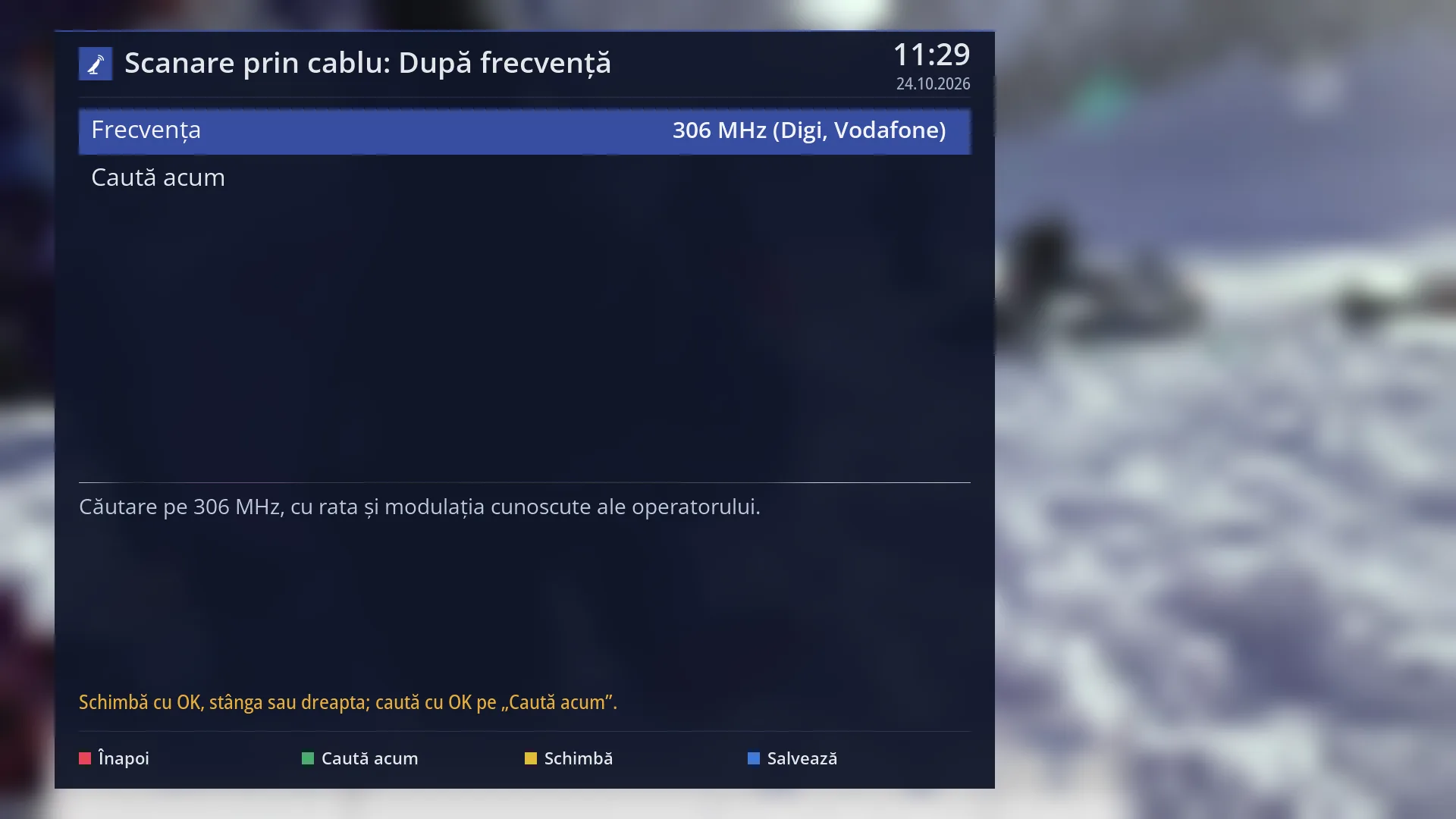
- 1 Kind of search: cable, by frequency.
- 2 The chosen frequency; OK opens the list of frequencies.
- 3 OK here starts the search.
- 4 What will be searched: the frequency and the attempts.
- 5 The status line: what the keys do or the last message.
- 6 RED back, GREEN search, YELLOW change, BLUE save.
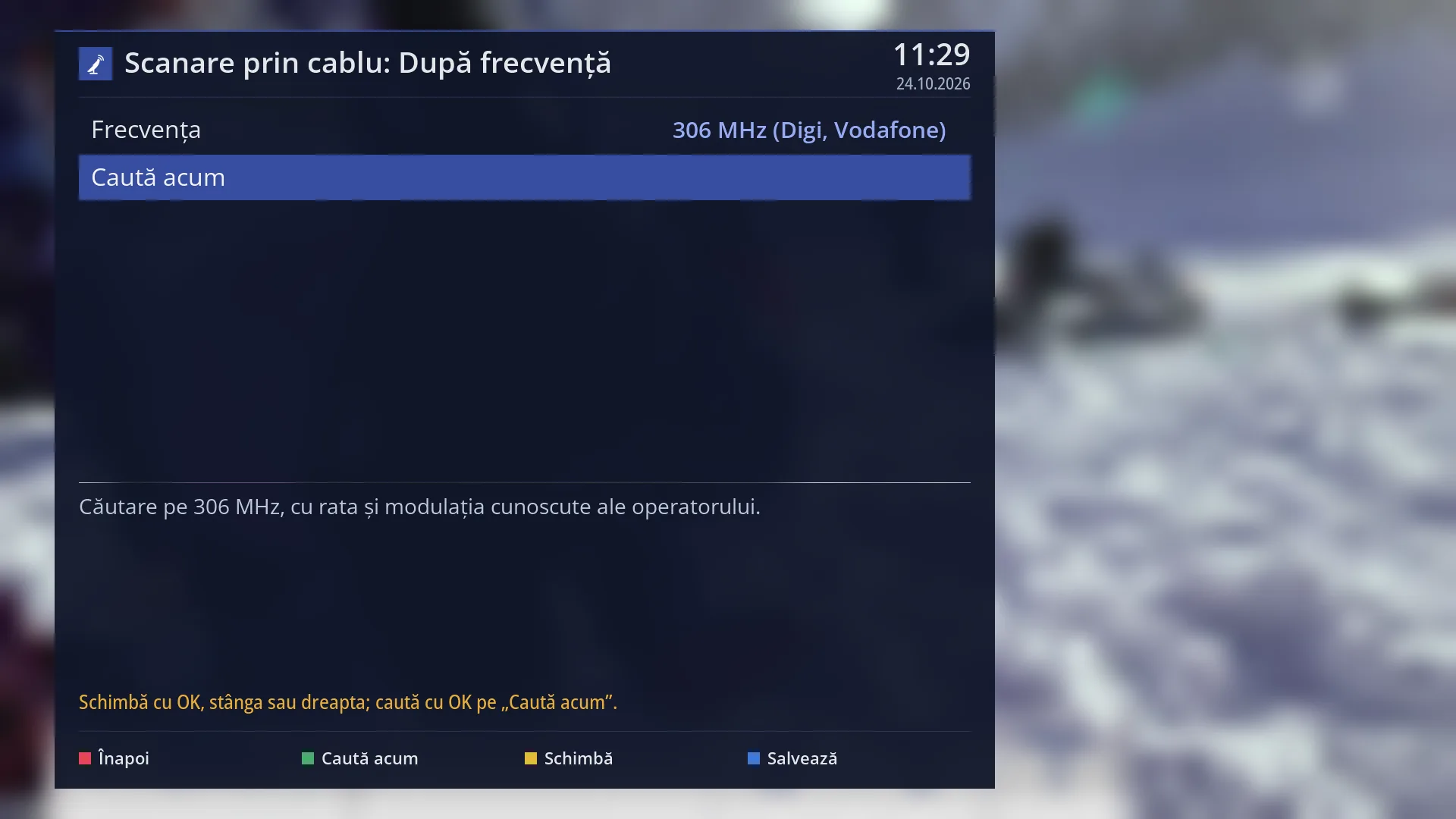
- 1 The selected row: “Search now”.
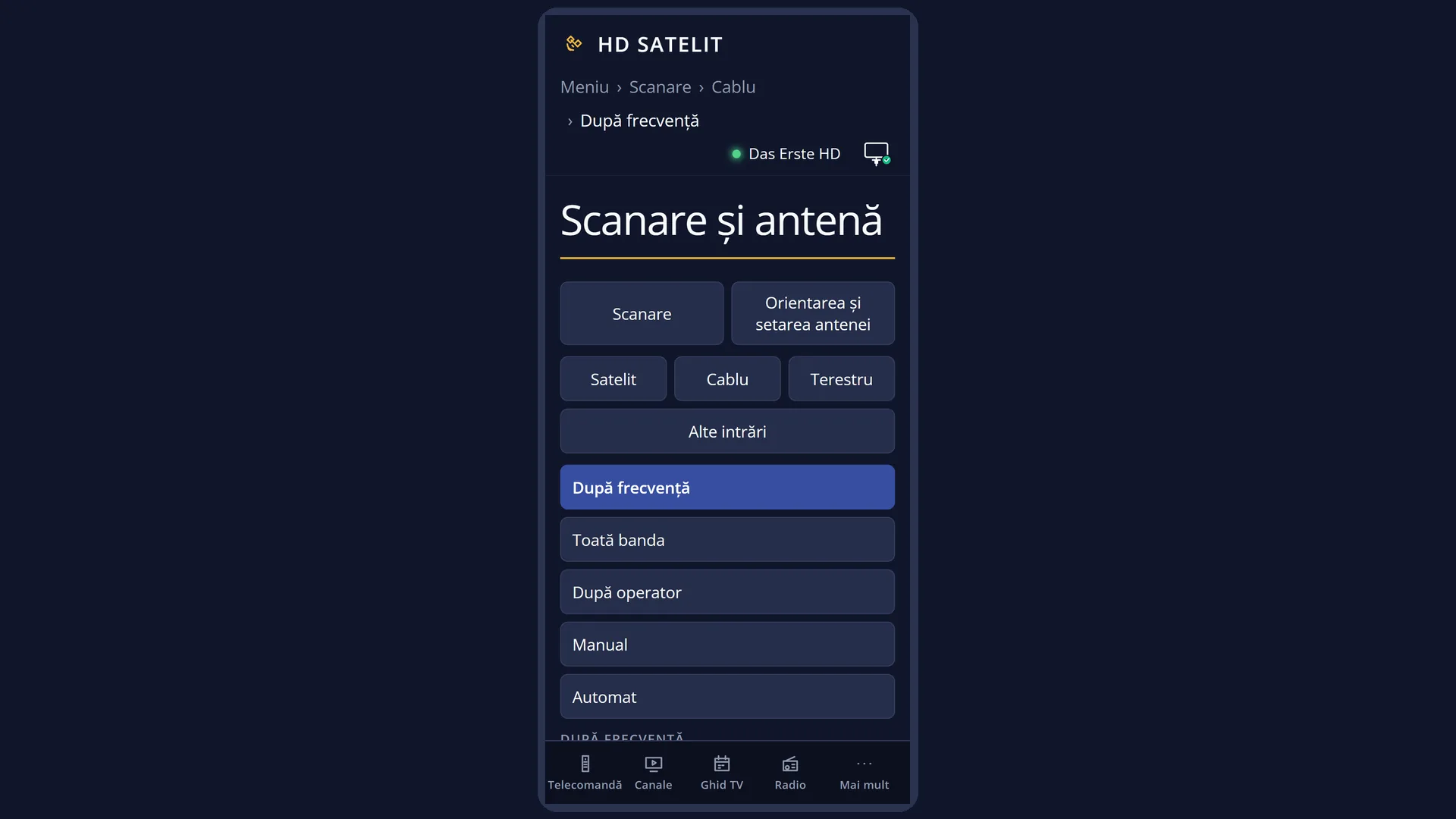
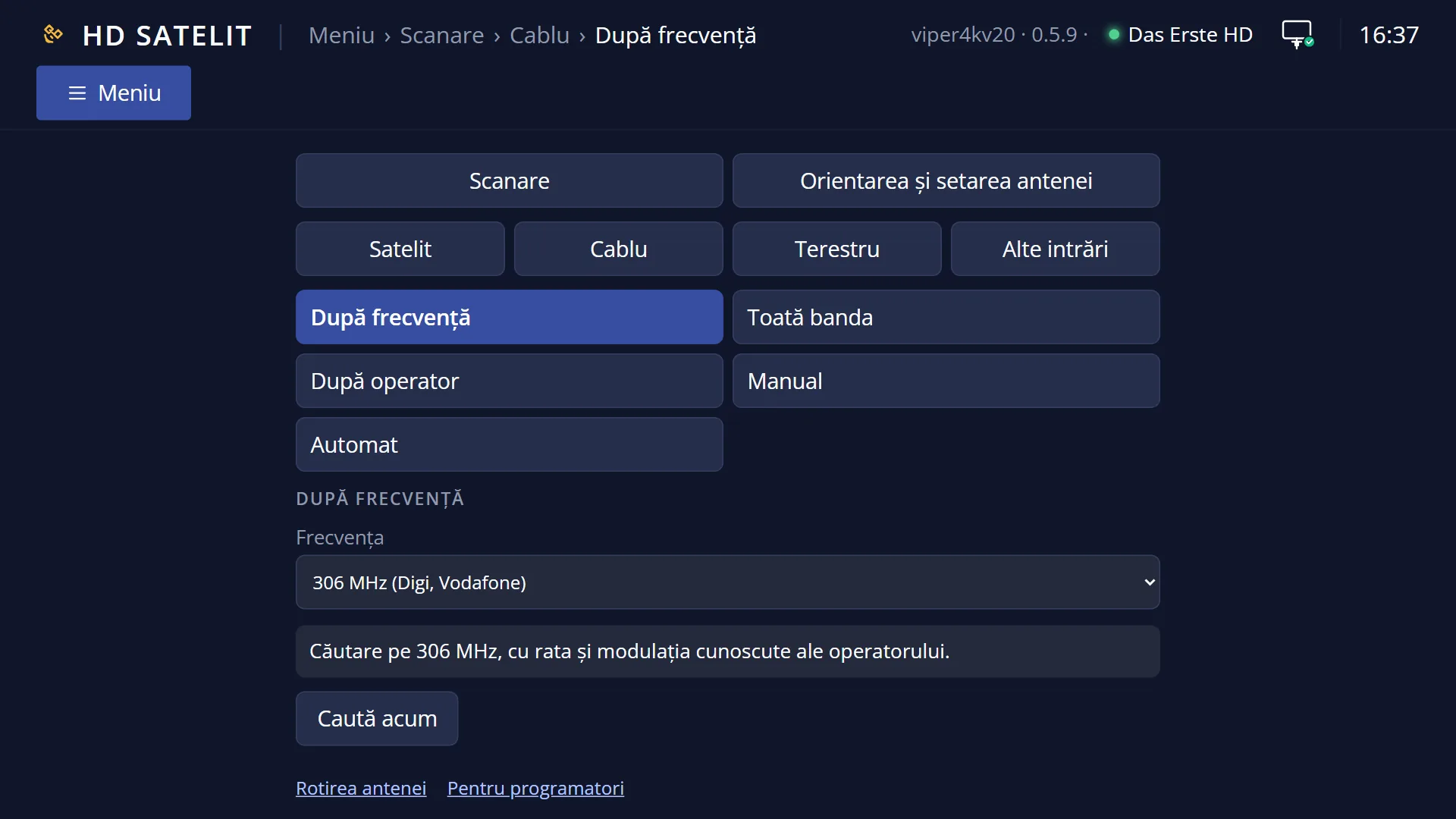
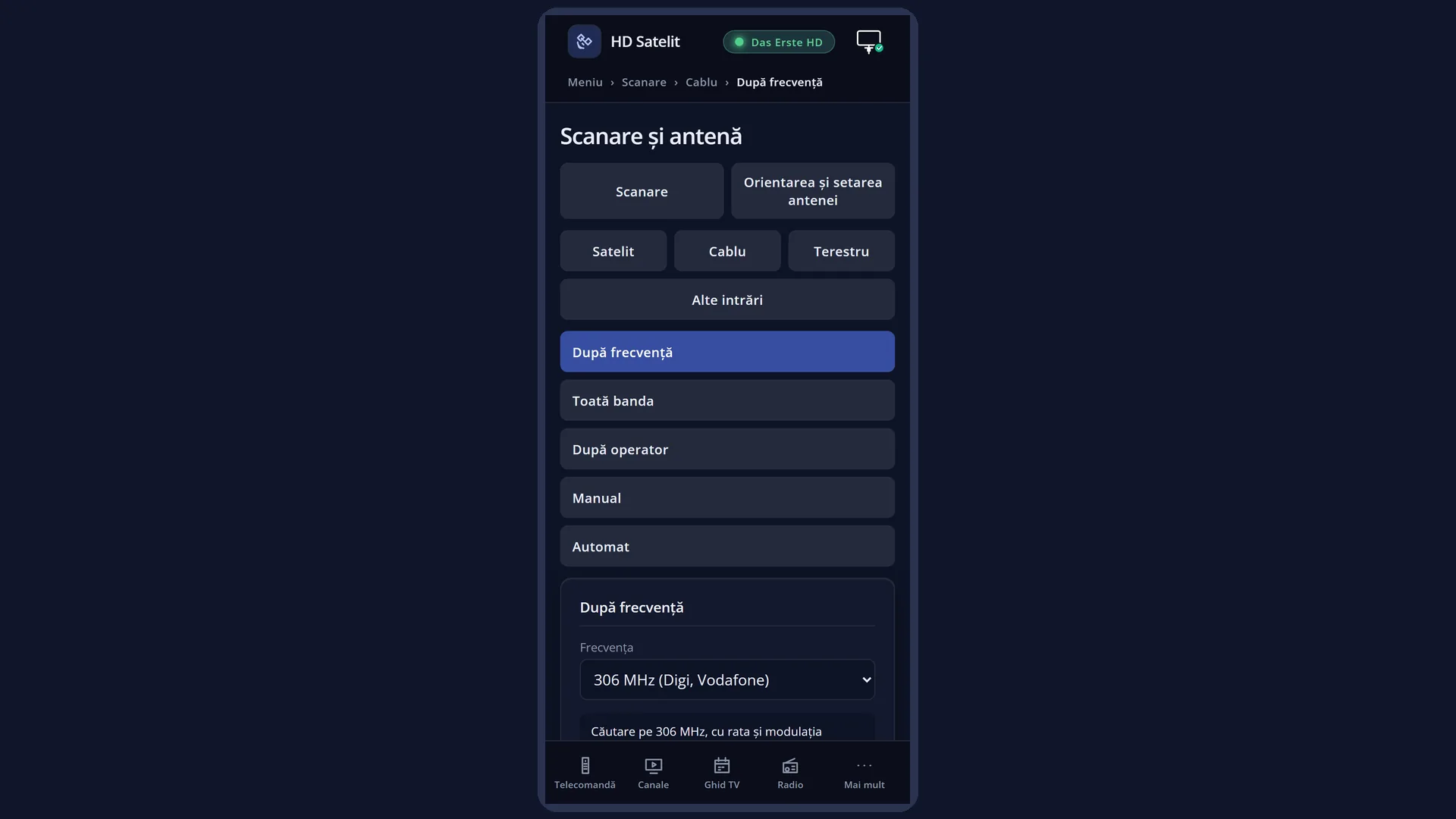
What it is for
“By frequency” searches for cable channels on a single frequency, chosen from a list. You do not type anything: you choose the frequency with OK or with the arrow keys.
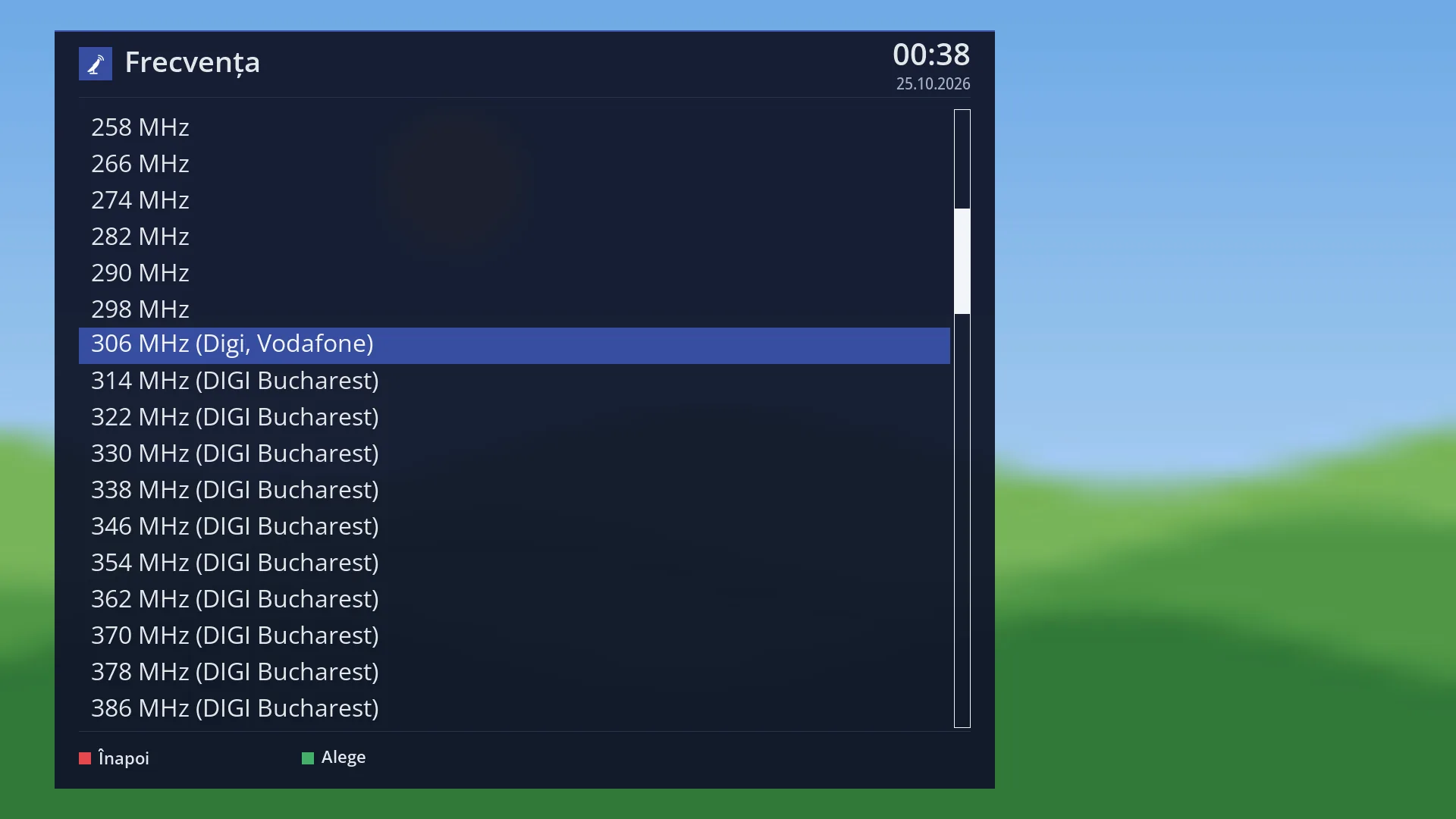
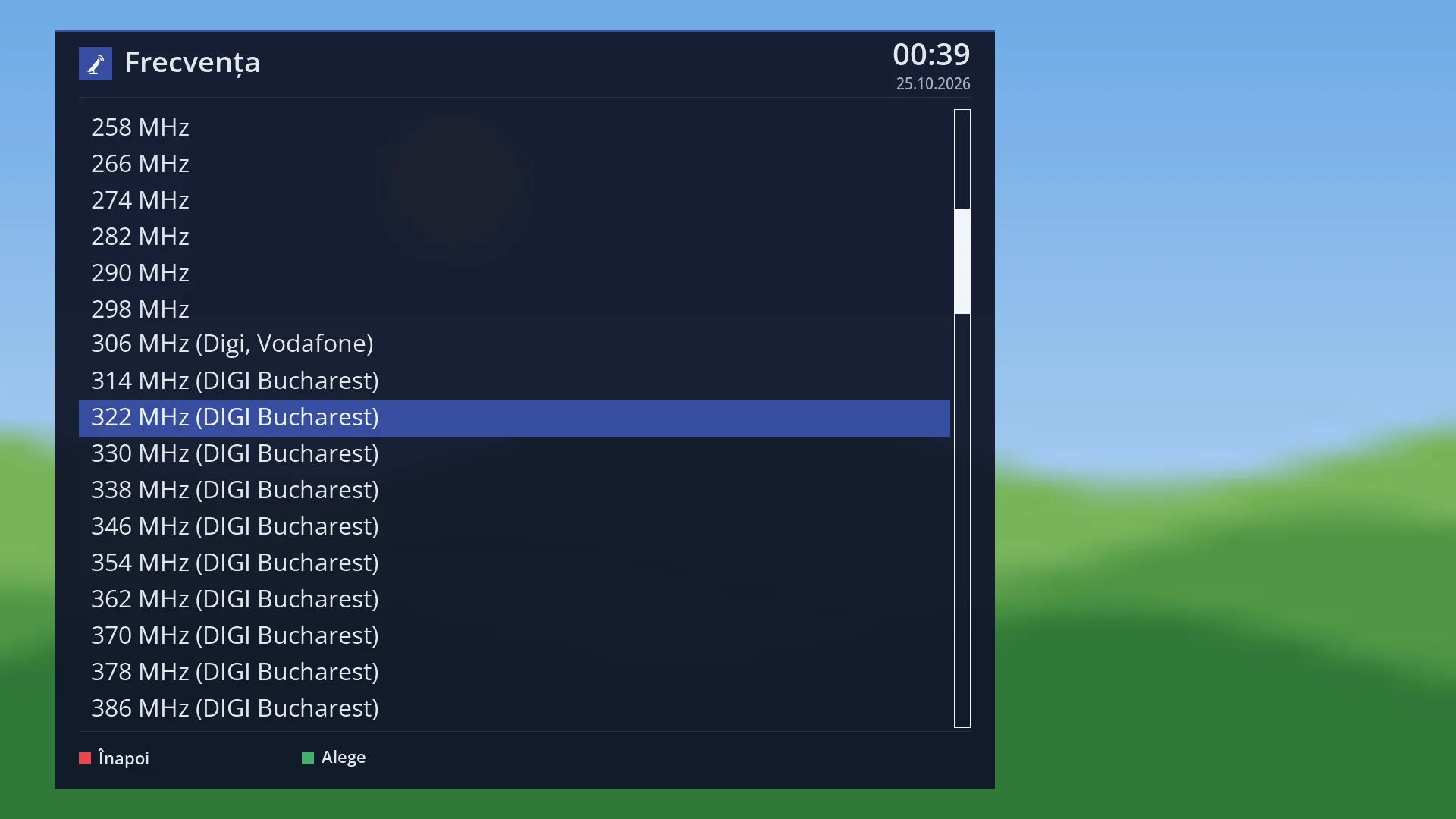
The list has every cable frequency in 8 MHz steps, from 122 to 858 MHz. The frequencies used by the providers in your country also show their names, for example “306 MHz (Digi, Vodafone)”.
You do not choose the symbol rate or the modulation. On a known provider frequency, the receiver uses the provider's values (at 306 MHz: 6900 kSymb/s, with QAM64 and QAM256). On the other frequencies it makes four attempts: 6900 and 6875 kSymb/s, each with QAM256 and QAM64.
The search stays on the chosen frequency. The network table in the signal is read only to get the network name and the channel numbers (the receiver waits for it for up to 12 seconds), and no other frequencies are added. For the whole network, use “Automatic” or “By provider”.
The channels found are added to the channel list; the existing ones are not deleted. The same kind of search is also in the web interface, on the page /scanare/cablu/frecventa.
How to get here
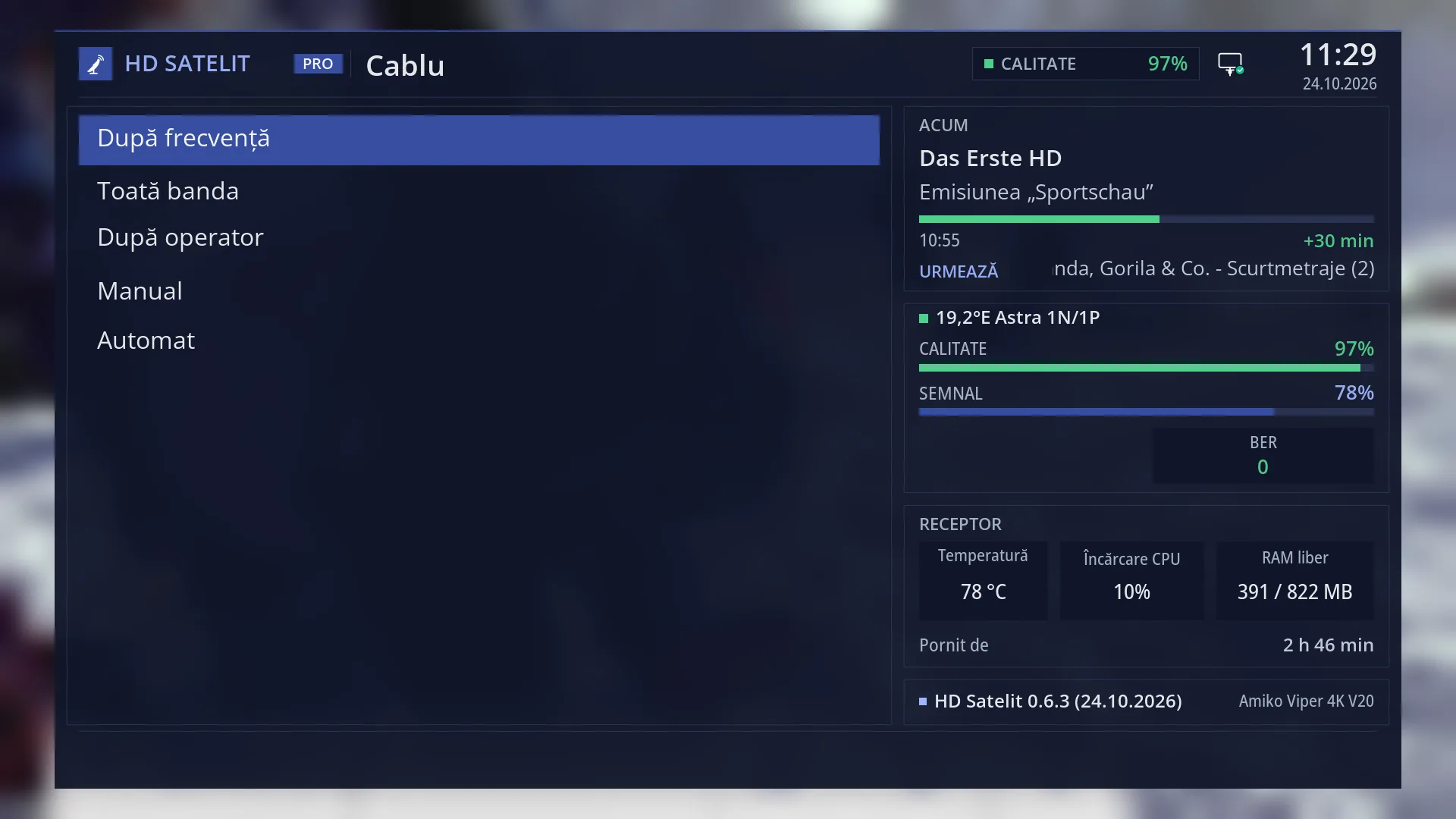
Path: Main menu > Channel scan > Cable > By frequency
Keys on the TV: MENU 1 2 1
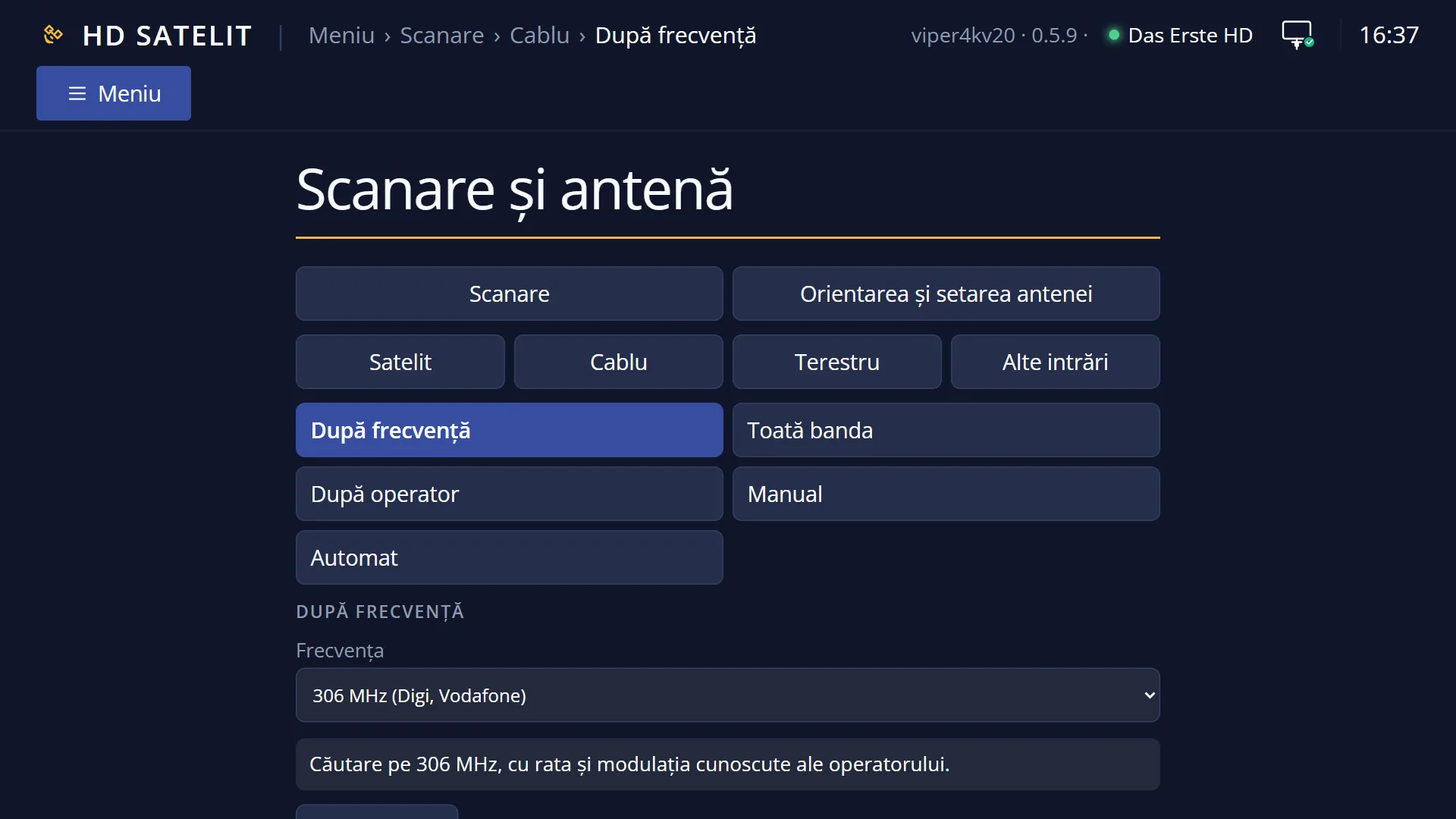
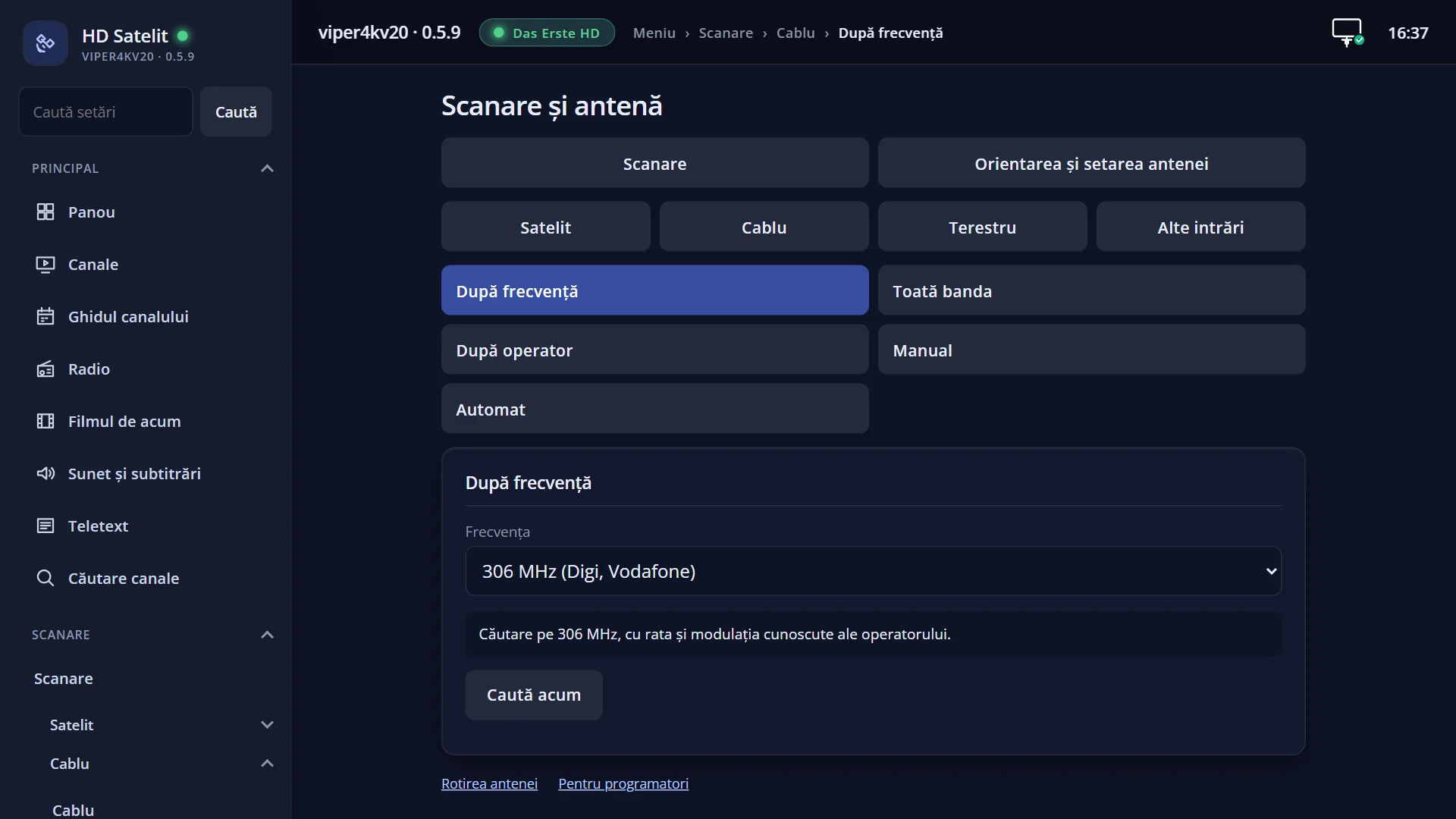
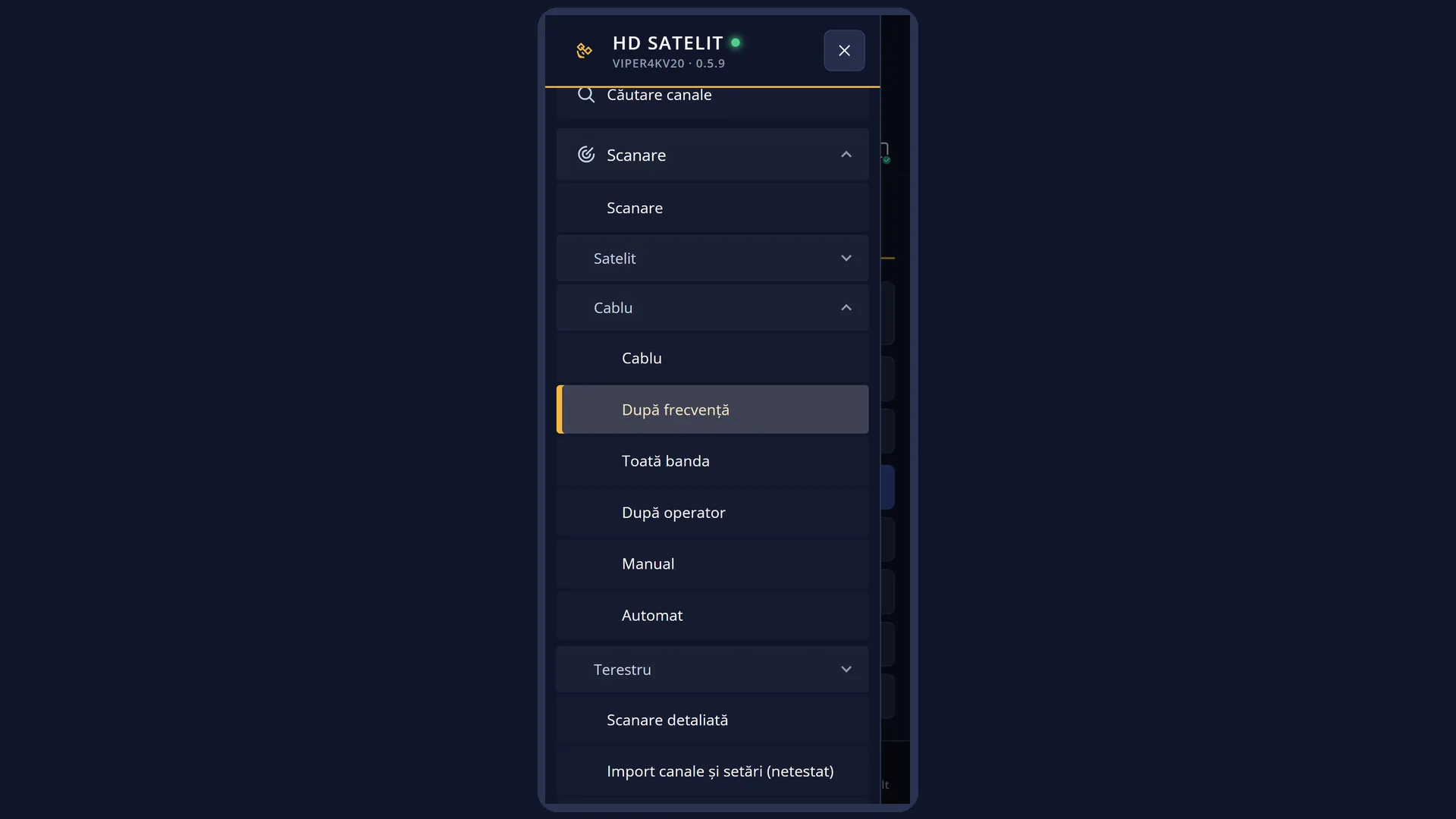
In the web interface: the page /scanare/cablu/frecventa (the “Channel scan” tab, the “Cable” group, the “By frequency” button).
What you see on the screen
At the top, the title “Cable scan: By frequency”, the time and the date. In the Pro theme, the blue square with the logo is to the left of the title.
The list has two rows: “Frequency”, with the chosen frequency on the right (in light blue), and “Search now”. The selected row has a blue background.
Below the list is the preview: what will be searched, for example “Search on 306 MHz, with the provider's known rate and modulation.” or “Search on 314 MHz: 4 attempts, with 6900 and 6875 kSymb/s, QAM256 and QAM64.”. It changes straight away for each frequency you choose and, like the GREEN key, tells you what will happen or why the search cannot run.
Below that, in yellow, is the status line. It usually tells you what the keys do: “Change with OK, left or right; search with OK on “Search now”.”. After the BLUE key it shows “Saved.”.
At the bottom, the colour keys: RED “Back”, GREEN “Search now”, YELLOW “Change”, BLUE “Save”.
OK on “Frequency” opens the list of frequencies, titled “Frequency”, across the whole window. At the bottom it has RED “Back” and GREEN “Choose”.
Once started, the “Service scan” screen opens: at the top “Cable” and the frequency being tried now, the moving dots and the text “search in progress - 50% done, 12 channels found”, the progress bar, “Time left: about …” and “Transponders: x of y”, and below them the last channels found.
At the end, the summary replaces the channels: “Channels found” and how many are new, how many are TV (HD, 4K) and how many radio, “Transponders scanned” and how many had “no signal”, and “Duration”. When the network sends its name, the “Operator network” box appears below: the network name, “Announced frequencies”, how many channels have the provider's number and where to find their list in number order (Satellites › Cable › the network name).
Rows and settings
| Row | Values | Default | What it does |
|---|---|---|---|
| Frequency | 122 MHz … 858 MHz, in 8 MHz steps, the frequencies of the providers in your country, with their names (for example “306 MHz (Digi, Vodafone)”, “706 MHz (Nextgen)”) | the first frequency of the first provider in your country (in Romania: 306 MHz, Digi); with no known provider for your country, none: the row shows “(choose with OK)” | The frequency to search on. Your country is the one of the menu language (for Romanian, Romania). The provider names in brackets help you find their frequency without knowing the number. When you search for the channels on another frequency of the network. |
| Symbol rate and modulation (chosen by the receiver) | the provider's values, on a known frequency, 4 attempts: 6900 and 6875 kSymb/s, with QAM256 and QAM64, on the other frequencies | depends on the frequency | This is not a row on the screen: it shows what the receiver tries on the chosen frequency. Almost all cable networks in Europe use 6900 or 6875 kSymb/s and QAM64 or QAM256. The same attempt coming from two providers is made only once. If you want other values, use “Manual”, where you enter them yourself. |
| Search now | OK on this row starts the search, like the GREEN key. The chosen frequency is remembered before the search starts. After you have chosen the frequency. | ||
| The channels found | They are written to the channel list only at the end of the search. The existing channels are not deleted; those found again are updated. You find them in the channel list under Satellites › Cable. |
Keys
| UP / DOWN | Moves the cursor between “Frequency” and “Search now”. From the last row, DOWN goes to the first, and the other way round. |
| LEFT / RIGHT | On “Frequency” they go to the previous or next frequency in the list, without opening it. Held down, they keep going. |
| OK | On “Frequency” it opens the list of frequencies. On “Search now” it starts the search. |
| GREEN | Starts the search from any row (the screen shows “Search now”). |
| YELLOW | On “Frequency” it opens the list, like OK (the screen shows “Change”). On “Search now” it does nothing. |
| BLUE | Remembers the chosen frequency and shows “Saved.” in the status line (the screen shows “Save”). |
| RED or EXIT | Closes the screen and takes you back to the Cable menu. The chosen frequency is remembered in this case too. |
| In the list of frequencies: UP / DOWN, LEFT / RIGHT | Moves the cursor one row or one page at a time. |
| In the list of frequencies: OK or GREEN | Chooses the highlighted frequency and closes the list. |
| In the list of frequencies: RED or EXIT | Closes the list without any change. |
| EXIT (on the “Service scan” screen) | During the search it stops it; the channels found so far are not written to the list. After the end, it closes the result. |
| OK (on the “Service scan” screen) | After the end it closes the result. While the search is running, it does nothing. |
Step by step
Searching for the channels on a provider's frequency
- Press MENU 1 2 1.
- On “Frequency” press OK, move the cursor to the frequency with the provider's name (for example “306 MHz (Digi, Vodafone)”) and press OK.
- Read the preview, then press GREEN.
- At the end, read the summary and press EXIT. If the receiver asks about the channel tracks, choose Yes to read them now or No to do it later.
Quickly finding out whether there is a signal on a frequency
- Press MENU 1 2 1 and choose the frequency with LEFT or RIGHT.
- Press GREEN.
- In the summary, “no signal” for all transponders means that nothing comes in on that frequency on your cable.
Starting the search from your phone
- Open the receiver's web interface and go to /scanare/cablu/frecventa.
- Choose the frequency from the list; below it you see the same preview as on the TV.
- Press “Search now” and follow the search in the “The search on the TV” card. “Stop the search” stops it; at the end, “Close the result on the TV” closes the summary on the screen.
Problems and solutions
The preview says “Choose the frequency from the list (OK).”
No frequency is chosen (we do not know any provider for your country, so there is no default one). Press OK on “Frequency” and choose one.
When you start, “The receiver has no de cablu tuner.” appears
Your receiver has no tuner for cable, so it cannot search for cable channels.
When you start, “The de cablu tuner (…) is set to “not connected” in Tuner settings. Turn it on there, then come back here.” appears
Open Menu > Dish alignment and setup > Tuner settings (MENU 2 1), turn on the cable tuner, then come back here.
The summary says “No transponder had a signal.”
No signal comes in on the chosen frequency. Check that the cable is plugged into the receiver's cable input and that the wall socket works with a TV, then try another frequency or “Whole band”.
I only found the channels of one frequency, not the whole network.
That is how this kind of search works. For the whole network, choose “Automatic” (MENU 1 2 5) with the same frequency or “By provider” (MENU 1 2 3).
I stopped the search with EXIT and I have no new channels.
The channels are written to the list only at the end of the search. Start it again and let it finish.
The web page says “A search is already in progress on the receiver. Wait for it to finish or stop it.”
A search is already running on the TV. Wait for it or stop it with “Stop the search”, then start yours.
Related topics
Differences between receivers
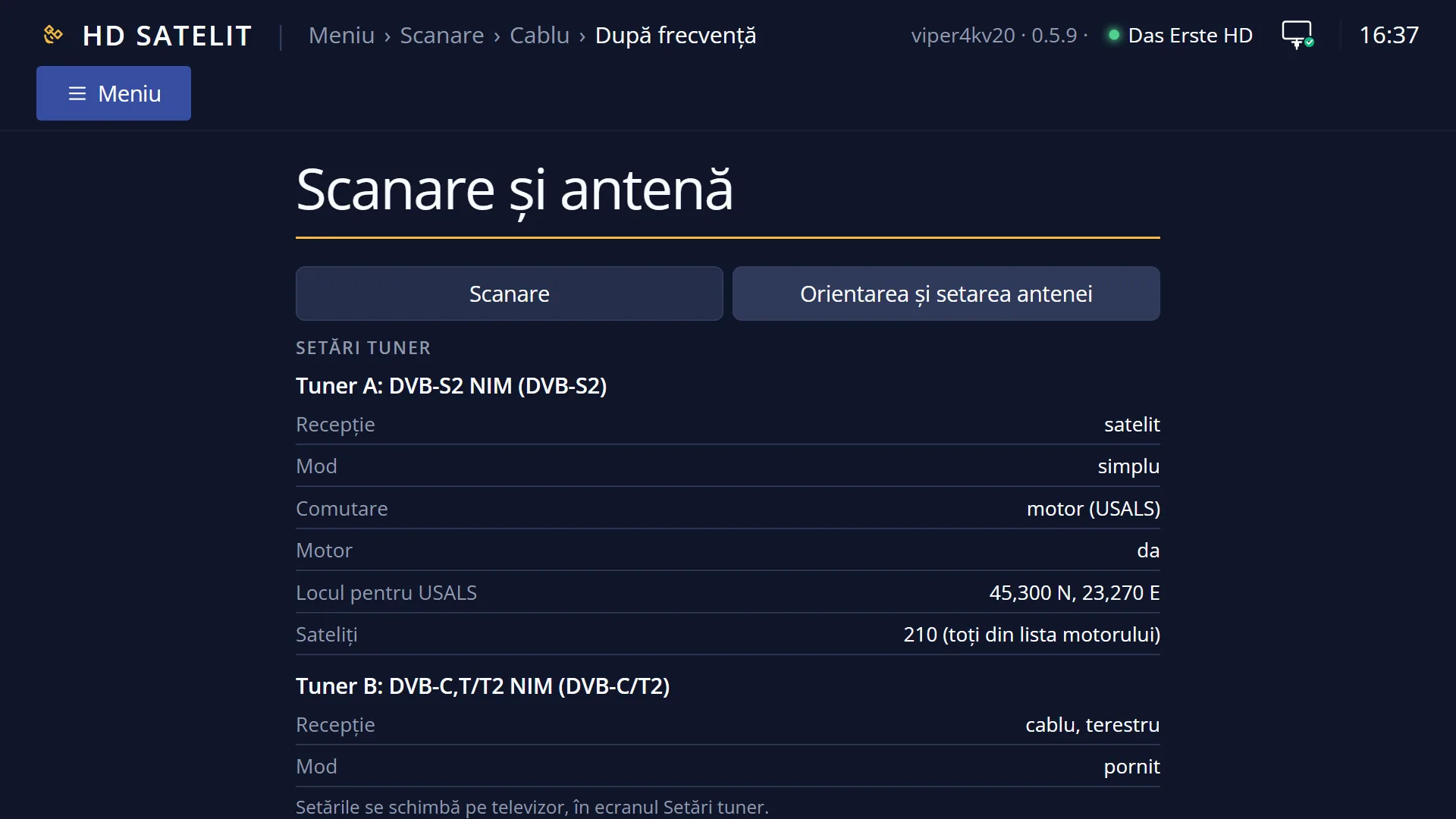
On the Amiko Viper 4K V20, the cable tuner is tuner B, a combined cable and terrestrial tuner: the search runs on it.